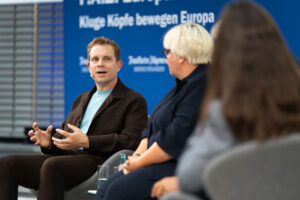
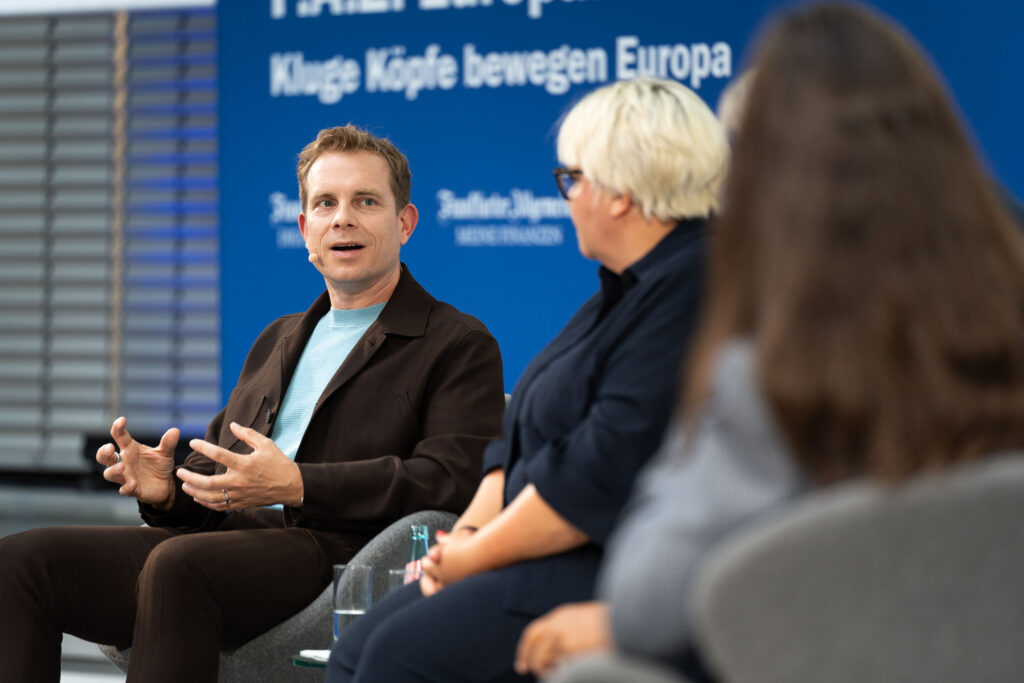
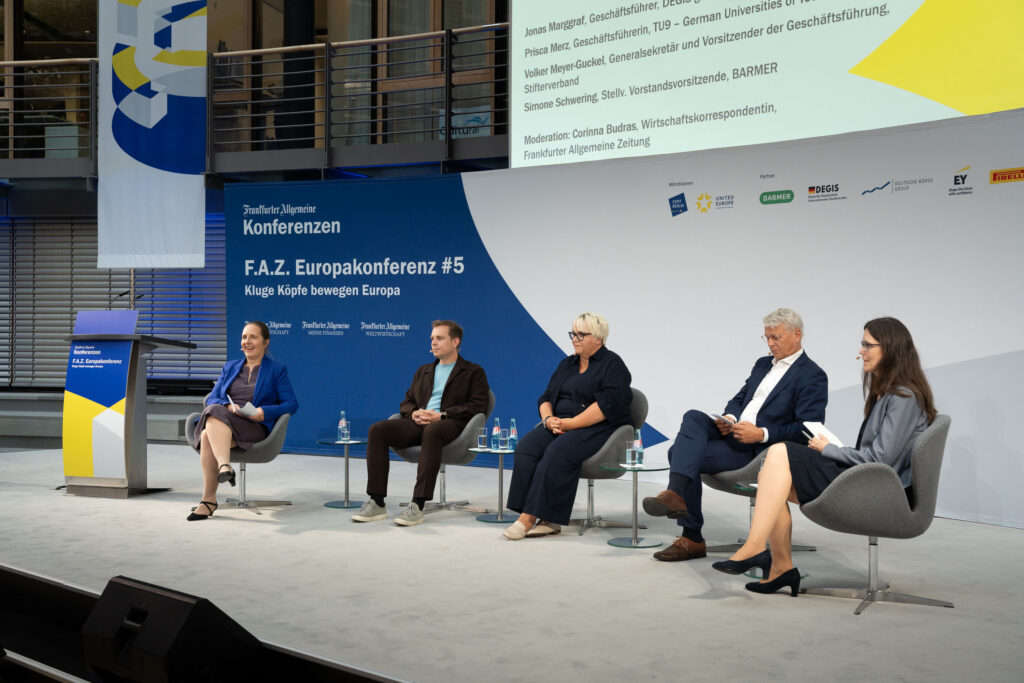
On 9 September 2026, DEGIS – the German Association for International Students – officially launched the DEGIS Policy Lab at the F.A.Z. Europakonferenz in Berlin. The launch took place during the panel “Wettbewerbsfaktor internationale Studierende – Gemeinsam Europas Zukunftsfähigkeit sichern” (“International students as a competitive factor – securing Europe’s future together”), part of the conference’s afaternoon programme on innovation and Europe’s competitiveness.
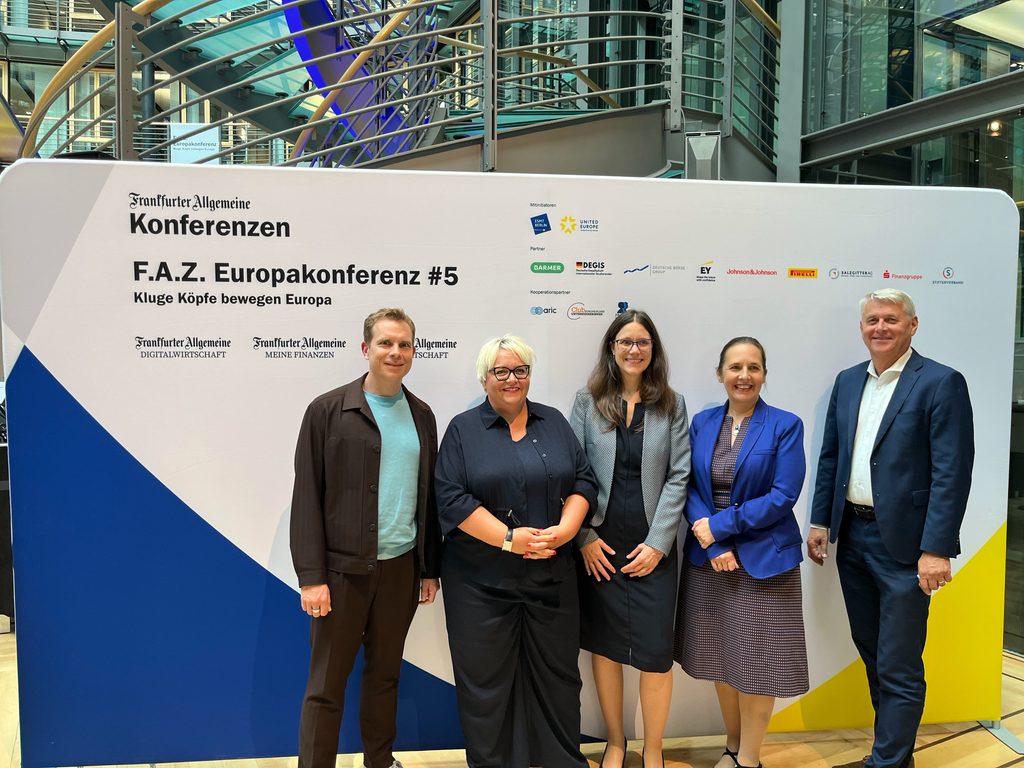
The panel was moderated by Corinna Budras, Business Correspondent at the Frankfurter Allgemeine Zeitung, and brought together Jonas Marggraf, Managing Director of DEGIS; Prisca Merz, Managing Director of the TU9 Alliance (German Universities of Technology); Simone Schwering, Deputy Chair of the Executive Board of BARMER; and Volker Meyer-Guckel, Secretary General and Chairman of the Executive Board of the Stifterverband.
To watch the panel discussion featuring DEGIS, access the full conference recording here. Our panel starts at 5:17:30.
What is the DEGIS Policy Lab?
Since 2019, DEGIS has built a volunteer-led community active in more than 35 cities across Germany, with 1,000 volunteers and more than 40,000 community members. Over time, this community work has increasingly turned into research. What began as individual discussion papers became a regular series, most recently Between Graduation and Career Entry – Internationals Employability Framework, published with the Stifterverband in May 2026.
The Policy Lab makes this a standing research initiative. It combines the lived experience of our community with data from network partners who support more than 100,000 international students each year. From this, it develops concrete policy recommendations on what helps international students succeed in Germany: in their studies, at work and in everyday life.
“Whether someone truly arrives here, finds a job and stays is rarely decided by their final grade. It’s decided by language, by practical experience, and by whether they have a network on the ground. Nobody crosses the world just to fill a labour gap – people arrive with a plan for their life here. Whether Germany delivers on that plan will decide whether they stay, and how competitive the country is in ten years.” – Jonas Marggraf.
Our first recommendation: invest in the university pathway
The Policy Lab’s opening recommendation is that Germany should concentrate its integration funding on the route that demonstrably works: the university pathway, end to end, from enrolment to career entry.
The evidence comes from the Internationals Employability Framework, a survey of 6,418 international students, graduates and professionals from 134 countries, conducted in September 2025. It found that:
- People who come to Germany via a university are three times as likely to find employment as those who don’t.
- Those who find a job are 60% more likely to stay in Germany permanently.
The timing matters. Almost a quarter of everyone working in STEM occupations in Germany, some 1.85 million people, is over 55 and will leave the labour market within the next ten years (Federal Employment Agency 2025, DEGIS calculations). In our view, closing that gap is less about opening new immigration channels than about funding the one with the strongest measurable impact.

Key takeaways from the panel
Germany’s reputation is strong, but it needs renewing
Germany is still the most attractive non-English-speaking study destination, thanks largely to free tuition and accessible healthcare. But as Jonas Marggraf put it, Germany risks living off its past reputation. “Made in Germany” still carries weight in countries such as India, yet there is no coordinated effort to promote Germany abroad. At international education fairs, he observed, the US, Canada and Ireland have large stands, while Germany may have little more than a roll-up banner.
The visa is the first impression
For many students, Germany’s welcome begins at the embassy, and it can be slow. The Skilled Immigration Act and centralised visa processing have brought improvements in some countries. But Prisca Merz described waits of up to 27 months in extreme cases, which push talented students towards faster destinations.
Late arrival has lasting effects. DEGIS’s first study, in 2019, found that 40% of international students arrived after the semester had started, missing orientation and the chance to integrate from day one.
Universities as service hubs
One of the main topics on the panel was the role universities play in supporting international students, and it’s closely tied to the Policy Lab’s first recommendation.
Many universities simply don’t have the capacity. A mid-sized university of applied sciences, for example, may have only 1.5 full-time staff in its international office. Marggraf suggested redirecting existing integration funding to universities, so they can become service hubs that support students all the way from enrolment to their first job.
The other panellists shared ideas on how this could work in practice. Simone Schwering suggested bringing services such as health insurance, authorities and visa offices together on campus, with documents in several languages and simple forms. She also noted that easy access to statutory health insurance is already one of Germany’s strengths.
Prisca Merz gave the example of Stuttgart, where the immigration office, the Federal Employment Agency, the university and local employers work together through a Welcome Center. She stressed that projects like this need long-term funding to be rolled out more widely.
Volker Meyer-Guckel added what the Stifterverband has learned from successful projects: the most effective ones start on a student’s first day and have the support of leaders such as university presidents and mayors.
Language and belonging
Language is the biggest hurdle, Jonas Marggraf said, yet few English-taught programmes require German courses through to graduation. Volker Meyer-Guckel added a second risk: student communities staying among themselves. Language courses achieve little without real connections on campus and in the wider city.
This is the gap DEGIS was built to close. Across more than 35 cities, our volunteer community connects international students with German students, universities and employers.
What comes next
We thank the F.A.Z. for hosting the conference, Corinna Budras for moderating, and Prisca Merz, Simone Schwering and Volker Meyer-Guckel for an open and practical discussion. Thank you also to everyone who visited the DEGIS stand.
The DEGIS Policy Lab will publish regular discussion papers on what helps international talent succeed in Germany. Sign up for Policy Lab updates or follow DEGIS on LinkedIn.